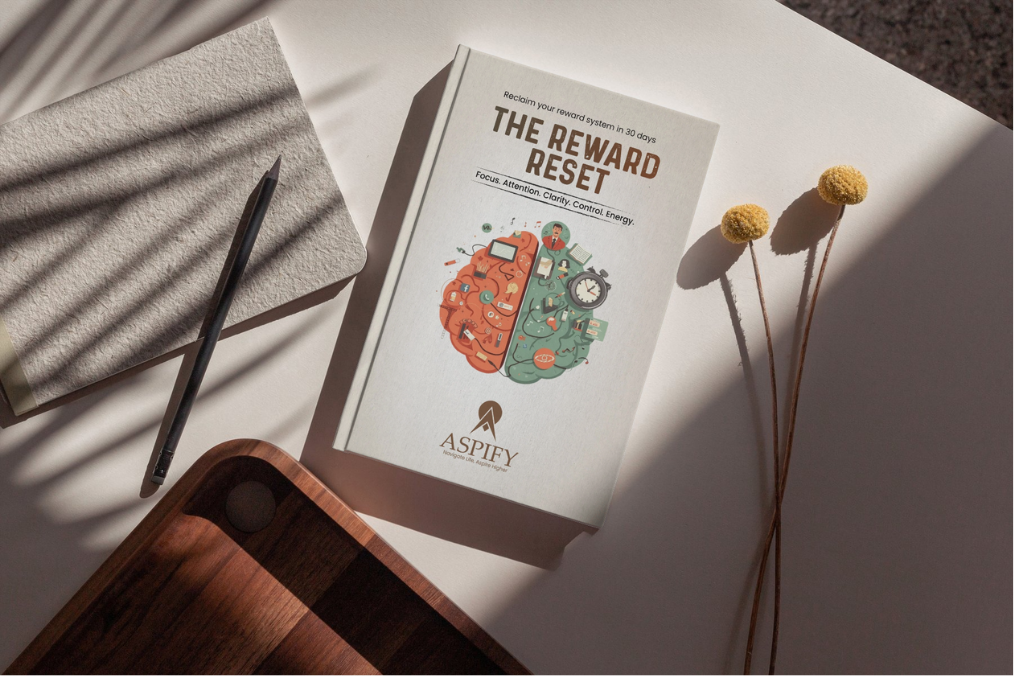
Psychological framework by Swaleha Asif Khanchey, Psychologist
You are not broken.
You are overstimulated.
Things that used to feel satisfying no longer quite do. You finish a scroll session and feel emptier than when you started. You are always reaching for the next thing before the current thing has ended.
This is not a discipline problem. This is what happens when your brain’s reward system has been running on cheap stimulation for long enough that it has stopped recognising real reward when it arrives.
Recalibration is simply lowering that threshold back to where it belongs. That is what 30 days does.
Not screen time numbers. Not deleting apps. Not willpower. Not a programme built for someone who lives alone, has two hours a day, and can disappear into a silent retreat.
This workbook was built knowing you probably live with family. That your obligations do not switch off. That you are navigating pressure from multiple directions at once. That if you have 10 minutes — not 60 — there needs to be a version of this that works for you. Your context is not an excuse. It is just the reality this workbook was designed inside. There is. It is this.
It works whether your pattern is your phone, your work, your food, your overthinking, or your inability to sit still for five minutes. You identify your own pattern in the first pages. Everything else is built around it.
Is This For You
These are not character flaws. They are what chronic overstimulation does to a reward system. They are also learnable habits — which means they can be unlearned.
Every day includes a morning reflection, a focused task, an evening reflection, and a WHY THIS WORKS note explaining what is happening in your brain that day. Not because you need a PhD — because understanding the why makes the how easier to follow through on.
You are not changing anything yet. You are watching yourself — noticing the patterns, the triggers, the automatic reaches. Awareness before action. Always.
This is where the real work happens. Gradual reduction of overstimulation. Replacing cheap dopamine with real reward. You will want to quit here. The workbook prepares you for that.
The habits you have been practising start to feel natural. This phase is about making them yours permanently — not as rules, but as the way you actually want to live.
Maps your personal Trigger → Urge → Reach pattern before Day 1, so every day’s work has something specific to test against.
60 precise emotion words organised by feeling state, so you stop writing ‘stressed’ and ‘bored’ as a reflex and find what is actually there.
A quick-reference guide that translates each compulsive behaviour into exactly what it is doing to your reward system — in plain language.
For the day you fall off. Not as a punishment. As a structured way back. A missed day is not a failed challenge.
Built to fill in after Day 20, when you have enough evidence to know what actually works for you — not what you think might.
Mood, focus, sleep, and anxiety logs across all four weeks, so you can see the shift — not just feel it.
This workbook will ask you to look at yourself honestly. Not harshly — honestly. There is a difference. Harsh is judgement. Honest is just seeing what is actually there.
I am a psychologist. I know what honest self-examination can surface. When you start looking at what you have been running from, you sometimes find it is bigger than a habit. This workbook is built with that in mind — with a note on when to seek support, not as a formality, but because I mean it.
What you will find here is not restriction. It is a structured invitation to understand something you have probably been doing automatically for a long time — reaching for relief the moment discomfort arrives. The work underneath it is the same for everyone. The pace and the pattern are yours.

Most of it will not be dramatic. Most of it will be quiet.